
How to Scale an AI Automation Agency From $5K to $50K Per Month
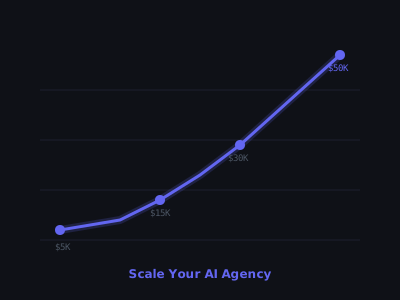
Most AI automation agency owners hit $5K per month and then stall. They're doing everything themselves, saying yes to every project, and burning out trying to figure out why revenue stopped growing. The jump from $5K to $50K is not about working harder — it's about identifying and clearing the specific bottlenecks at each growth stage.
This guide breaks down the exact framework for moving through three distinct phases: the solo operator phase ($5K–$15K), the systems phase ($15K–$30K), and the scale phase ($30K–$50K+). Each phase has its own constraints, its own priorities, and its own inflection points that unlock the next level. If you follow this progression methodically — rather than trying to skip steps — you can make this jump in 9 to 18 months depending on your niche, your sales cadence, and how quickly you build operational leverage.
Why Most AI Agencies Stall at $5K
At $5K per month, you're probably working with 3–5 clients on project-based work. You handle sales, delivery, revisions, and invoicing. Every hour is spoken for. When a new lead comes in, you either turn them away or say yes and work nights and weekends. The pipeline dries up every time you get busy with delivery, creating a painful boom-and-bust cycle that keeps you trapped at the same revenue level month after month.
The core problem is not your skill — it's your business model. Project-based, one-person operations have a hard revenue ceiling determined by how many hours you can work. To break through $5K, the first move is converting at least 50% of your revenue to monthly retainers. One client paying $2,500/month is worth more than three $2,500 projects, because retainer revenue compounds while project revenue restarts to zero every month.
Think about the math this way. If you close two $2,500 projects per month, you earn $5K. Next month, you start from zero again. But if you convert those same two clients to $2,000/month retainers, you earn $4K in month one, $8K in month two when you add two more, $12K in month three, and so on. Even if you only close one new retainer client per month, your revenue compounds because the old ones stay. That compounding effect is the entire engine of agency growth.
There is also a psychological shift that happens when you stop chasing one-off projects. You stop underpricing to win work. You stop treating every deal as desperate. You start thinking about lifetime client value instead of invoice amounts, and that mindset change alone makes you a better salesperson and a better operator.
Phase 1: $5K to $15K — Build the Retainer Foundation
The goal of this phase is simple: stop selling projects, start selling recurring service agreements. Here's what that looks like in practice.
Convert Existing Clients to Retainers
Take your best 2–3 existing clients and present them with a monthly support and optimization retainer. Position it as ongoing AI system maintenance, reporting, and expansion — not just implementation. A typical retainer at this stage ranges from $1,500 to $3,000/month depending on scope. Three clients at $2,000/month gives you $6K in predictable base revenue before you land a single new client.
The conversion conversation is straightforward. After delivering a project, schedule a 15-minute call and walk through three things: the results they have seen so far, the performance improvements you would make over the next 90 days, and the new automation opportunities you have identified while working inside their business. Frame the retainer as a way to capture those opportunities without re-engaging from scratch each time. Most clients who are happy with your project work will say yes — they just need to see the ongoing value clearly articulated.
What goes into a $2,000/month retainer at this stage? Typically it includes monitoring and maintenance of existing automations, one new automation build or expansion per month, a monthly performance report with key metrics, priority Slack or email support with a 24-hour response SLA, and a monthly strategy call to identify new opportunities. This is enough work to justify the price while remaining manageable for a solo operator with 5–6 retainer clients.
Productize Your Core Offer
Pick one high-demand AI automation service and build a repeatable delivery process around it. Lead qualification bots, cold email systems, and missed-call-text-back automations are all strong candidates. When you productize, you can quote faster, deliver faster, and delegate faster later. A productized offer also converts better in sales conversations because prospects know exactly what they're getting.
Productizing means creating a fixed-scope, fixed-price offer with a clearly defined deliverable and timeline. For example, instead of saying you build custom AI automations, you offer an AI Lead Response System that includes a chatbot on their website, automated lead qualification, CRM integration, and SMS follow-up — deployed in 10 business days for a $3,500 setup fee plus $2,000/month retainer. That specificity eliminates scope creep, reduces the number of revisions, and makes your sales pitch dramatically more convincing because the prospect can visualize exactly what they are buying.
Here is a simple test for whether your offer is productized enough: could you hand the delivery checklist to a competent freelancer and have them build it without calling you for clarification? If yes, you are ready. If not, keep refining the scope, the steps, and the documentation until you can.
Set Up Your Sales Pipeline at $5K–$15K
At this stage, you do not need a complex sales infrastructure. What you need is a consistent rhythm. Block 90 minutes every weekday morning for outreach before you touch client work. Send 20–30 personalized cold emails or LinkedIn DMs per day targeting a single niche. Track everything in a spreadsheet or simple CRM with four columns: prospect name, last touch date, stage (cold, replied, booked, pitched, closed), and deal value. Consistency beats volume at this stage — 20 targeted messages per day to dentists will outperform 100 generic messages to random business owners.
The $15K Milestone Checkpoint
You hit $15K when you have 5–6 retainer clients paying $2,000–$3,000/month each. At this point, your bottleneck shifts from revenue to capacity. You're spending 30+ hours per week on client work and have almost no time for sales. This is the signal to hire. Do not wait until you feel ready — if you are at $15K and drowning in delivery, you are already behind on hiring.
For a detailed guide on converting project clients to retainers, see our post on creating predictable recurring revenue.
Phase 2: $15K to $30K — Build Systems and Your First Hire
This is where most agency owners make the most expensive mistake: they keep doing everything themselves while turning away clients. The key move here is hiring a junior automation specialist or a capable VA to handle delivery while you focus on sales and client relationships. Every week you delay this hire, you leave money on the table because you are turning away clients or delivering late to existing ones.
Document Everything Before You Hire
Before bringing anyone on, spend two weeks documenting your delivery process. Create a Loom walkthrough for every repeatable task. Write SOPs for client onboarding, automation builds, and revision requests. This documentation becomes your training program and reduces onboarding time from months to weeks.
A practical approach to documentation: for the next two weeks, every time you do a task that you would eventually want someone else to do, record your screen and narrate what you are doing and why. At the end of two weeks, you will have 15–25 Loom videos covering your entire delivery process. Organize these into folders by category — onboarding, build, QA, reporting, client communication — and write a one-page checklist for each category summarizing the steps. That is your training library. It does not need to be perfect. It needs to exist.
Who to Hire First and Where to Find Them
Your first hire should be someone who can take over 60–80% of your delivery workload. For most AI automation agencies, that means a junior automation specialist who is familiar with tools like n8n, Make, or Zapier and can follow documented processes. You are not looking for a strategist or a salesperson — you are looking for someone reliable who can execute builds from your templates and SOPs.
The best places to find this person are Upwork (filter for automation or integration specialists with 50+ hours logged), niche Slack and Discord communities around no-code tools, and referrals from other agency owners. Start them as a part-time contractor at 15–20 hours per week. Pay $20–$40/hour depending on skill level and location. If they work out after 30 days, move them to a fixed monthly rate and increase their hours.
The First Hire ROI Calculation
If a junior VA costs you $1,500/month and frees up 20 hours/week of your time, and you use those 20 hours to close one additional $3,000/month retainer client, that hire pays for itself 2x in month one. The math almost always works — most agency owners just fear the upfront cost without doing the calculation.
Run the numbers for your specific situation. How many hours per week are you spending on delivery? If a hire takes over 15 of those hours and you use even half of that freed time for sales activities, how many additional discovery calls can you book per week? At a 25% close rate, how many new clients does that produce per month? Multiply that by your average retainer value. Compare it to the cost of the hire. In nearly every scenario, the hire generates 2–4x its cost in new revenue within the first 60 days.
For a complete hiring playbook, read our guide on hiring your first AI automation agency employee.
Raise Prices Mid-Phase
Between $15K and $30K, raise your retainer prices by 20–30%. New clients come in at $2,500–$4,000/month. Existing clients get a 60-day notice and a value presentation before the increase. Most well-served clients stay. At this stage, losing one client to a price increase is acceptable — you can replace them at higher rates.
The value presentation matters. Do not just send an email saying prices are going up. Schedule a call, walk through the results you have delivered over the past 3–6 months, show them the ROI calculation (leads generated, time saved, revenue attributed), and then present the new pricing alongside an expanded scope. For example, if they were paying $2,000/month and you are moving to $2,800/month, add a second monthly automation build or a quarterly strategy session to the package. Most clients will accept a 20–30% increase when paired with additional value. The ones who leave were likely undervaluing your work already.
For the exact process of raising prices without losing clients, see our guide on raising AI automation agency prices.
The Systems You Need at $20K-$30K
At this stage, build these operational systems:
- Client onboarding SOP: A step-by-step process that can be executed by your hire, not just by you. This should cover the kickoff call agenda, access and credential collection, initial audit, project setup in your PM tool, and the first-week deliverables timeline.
- Monthly reporting template: A standardized report format that takes under 15 minutes per client. Include key metrics (leads generated, automations triggered, time saved), a summary of work completed, and recommendations for next month.
- Automation template library: Pre-built workflows for your most common use cases that can be cloned and customized. If you build lead qualification bots, have a base template that your hire can duplicate and configure for each new client in under two hours instead of building from scratch.
- Sales pipeline tracker: A CRM or spreadsheet tracking every prospect from first touch to close. At minimum, track: lead source, first contact date, discovery call date, proposal sent date, close date, and deal value.
- Quality assurance checklist: A pre-deployment verification process for every automation before it goes live. This should include testing with sample data, checking error handling, verifying integrations, confirming notification triggers, and a final sign-off from either you or a senior team member.
Phase 3: $30K to $50K — Build the Sales Machine
Getting to $30K is an execution problem. Getting from $30K to $50K is a sales and positioning problem. At this stage, you need inbound leads, a second salesperson or a reliable outreach system, and a service portfolio that supports $5K–$10K/month clients. The shift here is subtle but important: you are no longer just an automation builder — you are positioning yourself as an AI strategy partner for businesses that need comprehensive solutions.
Build an Outbound System That Runs Without You
By $30K, you should have a cold email or LinkedIn outreach system running semi-automatically. This means 50–100 new outreach touches per day going out with minimal manual intervention. Tools like Ciela's LinkedIn automation combined with a well-built cold email infrastructure can generate 5–10 qualified conversations per week at scale. From those conversations, closing even two per month at $4,000/month retainer adds $8K MRR.
The outbound system has three layers. First, lead sourcing: use Apollo, LinkedIn Sales Navigator, or similar tools to build targeted lists of decision-makers in your niche. Filter by company size (10–200 employees is the sweet spot for most AI agency services), industry, location, and title. Second, sequencing: set up multi-touch sequences that combine email and LinkedIn touchpoints over 14–21 days. A typical sequence might be: Day 1 LinkedIn connection request, Day 3 email, Day 7 follow-up email, Day 10 LinkedIn message, Day 14 breakup email. Third, qualification: have a VA or SDR handle the initial responses, book discovery calls on your calendar, and send a pre-call questionnaire so you walk into every conversation prepared.
The key metric to track is qualified conversations per week. At $30K+ MRR, you need 5–10 new sales conversations per week to maintain growth. If your outbound system is producing fewer than that, increase volume or improve targeting before trying anything else.
Move Upmarket — Offer Larger Engagements
The fastest path from $30K to $50K is adding 1–2 high-value clients paying $8K–$15K/month for comprehensive AI automation programs. These are typically mid-market companies or agencies looking to white-label your services. You win these by having case studies, a repeatable process, and the confidence to charge premium rates. At this stage, you shouldn't be afraid to present a $10K/month proposal.
What does a $10K/month engagement look like? It typically covers multiple business functions — not just lead generation, but also customer onboarding, internal operations, and reporting. You might be building and maintaining 10–15 active automations across their sales, support, and operations teams. The scope includes a dedicated automation specialist on their account, weekly strategy calls, priority support, and a monthly innovation session where you identify new automation opportunities. These larger clients also tend to have longer contracts — 6 to 12 months — which further stabilizes your revenue base.
To find these clients, look at two segments. First, mid-market companies with 50–200 employees that have outgrown basic tools but are not large enough to build an in-house automation team. Second, marketing agencies and consultancies that want to add AI automation to their service offering without hiring specialists. The white-label model is particularly powerful because one agency partner can represent $10K–$20K/month in ongoing revenue with relatively low sales effort after the initial deal closes.
Build Inbound Lead Generation
At $30K+ MRR, invest in content that generates inbound leads. This means: regular LinkedIn posts sharing results and insights, a blog targeting long-tail keywords in your niche, case study pages on your website, and potentially a free community or newsletter. Inbound leads close at 2-3x the rate of outbound because they already trust you before the first call.
A practical content cadence at this stage: publish three LinkedIn posts per week (one case study, one tactical tip, one opinion or insight), one long-form blog post per week optimized for a keyword your ideal clients search, and one case study per month with specific numbers and outcomes. You do not need to create all of this content yourself — this is where a part-time content creator earns their keep. Give them access to your client results, your frameworks, and your voice, and let them turn it into published content.
The compounding nature of content is similar to retainers. A blog post published today continues generating traffic and leads for months or years. A LinkedIn post that resonates gets shared and seen by prospects you never would have reached through cold outreach. After 6 months of consistent content, most agencies see 30–50% of their new conversations coming from inbound — and those leads are warmer, close faster, and churn less.
The $50K Org Chart
At $50K/month, a typical AI automation agency has: one founder focused on sales and strategy, one senior automation specialist managing delivery, one junior VA handling admin and simple builds, and a part-time content creator for inbound. Total team payroll: roughly $8K–$12K/month, leaving $38K–$42K gross margin before tools and overhead.
The founder's time at this level should be split roughly: 40% on sales and business development, 30% on strategy and high-value client relationships, 20% on team management and systems improvement, and 10% on content and thought leadership. If you are still doing delivery work at $50K/month, you have a delegation problem, not a growth problem. Your senior specialist should be running 90% of client work autonomously, with you stepping in only for strategic conversations and escalations.
The Five Inflection Points That Change Everything
Across hundreds of AI agency journeys, five specific moments consistently unlock the next revenue level:
- First retainer client: Converts your thinking from project-based to recurring-revenue. This single shift changes how you price, how you sell, and how you plan. You stop thinking in terms of project margins and start thinking in terms of lifetime value.
- First price increase: Forces you to articulate your value rather than justify your rate. The first time you tell a client your price is going up and they agree without pushback, you realize you were undercharging all along. This moment recalibrates your pricing confidence permanently.
- First hire: Breaks the one-person ceiling and forces process documentation. It is uncomfortable, expensive at first, and transformative. The moment someone else can deliver your service at 80% of your quality, you unlock the ability to grow revenue without growing your hours.
- First inbound lead: Proves that content or SEO is working and reduces outbound dependency. When a qualified prospect books a call from a blog post or LinkedIn post you published three months ago, you see the compounding flywheel in action for the first time.
- First $10K client: Reshapes your beliefs about what's possible and what you should charge. Landing a five-figure monthly retainer eliminates the mental ceiling that kept you pitching $1,500 deals. After your first $10K client, you will never go back to underpricing.
Common Mistakes That Kill Growth
The biggest growth killers at the $5K–$50K stage are: trying to serve every niche instead of one, keeping prices artificially low out of fear, refusing to hire before they feel "ready," and confusing being busy with making progress. Revenue clarity comes from tracking MRR, churn rate, average contract value, and sales conversion rate — not hours worked.
Another common mistake is scope creep on retainer accounts. When a client asks for one more thing each month and you say yes without adjusting the price, you slowly degrade your margins and burn out your team. Build clear scope boundaries into every retainer agreement and have a documented process for handling out-of-scope requests. If a client consistently needs work beyond the agreed scope, that is a conversation about upgrading their plan — not a reason to absorb free labor.
A third mistake is neglecting churn. Acquiring a new client at $3,000/month means nothing if you lose an existing client the same month. At the $15K–$30K stage, reducing churn from 10% to 5% has the same revenue impact as doubling your sales close rate. Invest in quarterly business reviews with each client, proactive communication about results, and regular check-ins that go beyond just delivering work. Clients leave when they feel forgotten or when they cannot see the value — both of which are preventable.
The Metrics Dashboard You Need
Track these numbers weekly:
- MRR: Total monthly recurring revenue from all retainer clients.
- Churn rate: Percentage of clients lost per month. Target under 5%.
- Average contract value (ACV): Average monthly retainer per client. Should increase as you raise prices.
- Sales conversion rate: Percentage of discovery calls that convert to signed clients.
- Pipeline value: Total potential MRR from all active sales conversations.
- Effective hourly rate: Total revenue divided by total hours worked. Should increase every quarter.
Review these numbers every Monday morning before you start the week. If MRR is growing but your effective hourly rate is declining, you are scaling your workload, not your business. If your pipeline value is low relative to your growth target, you need more outreach. If your close rate drops below 20%, revisit your sales process or your targeting. These numbers tell you exactly where to focus each week — follow them instead of your instincts.
For a full breakdown of how to price your services at each stage, read our guide on AI agency pricing for retainers and projects. And if you're still building toward your first $5K, start with how to start an AI automation agency in 2026.
Frequently Asked Questions
Want to learn how to build and sell AI automations? Join our free community. Join the free AI Automation Sprint community.
Join 215+ AI Agency Owners
Get free access to our all-in-one outreach platform, AI content templates, and a community of builders landing clients in days.