
How to Hire Your First Employee for Your AI Automation Agency (Without Guessing)
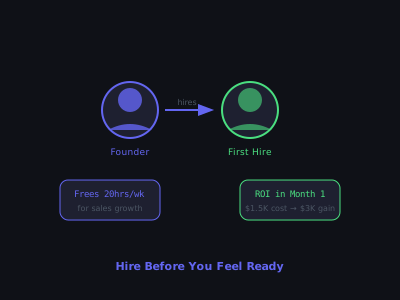
Most AI agency owners wait too long to hire. They convince themselves they need more revenue, more systems, or more certainty before bringing someone on. Meanwhile, they are the bottleneck on everything — delivery, sales, client communication, admin — and the business cannot grow past the capacity of one person. This guide covers when to hire, who to hire first, where to find them, and how to onboard them without creating more work for yourself than they save.
The Three Signals That Mean It Is Time to Hire
The first signal: you are turning down qualified leads because you do not have capacity to deliver. If you have said no to a client or delayed a start date because you are too busy, the cost of not hiring is already higher than the cost of hiring. The second signal: you spend more than 60 percent of your time on delivery tasks rather than sales, strategy, or client relationships. If you are doing work that someone else could do at $20 to $30 per hour while you could be doing work that generates $100 to $200 per hour, you are trading revenue for busyness. The third signal: your MRR has been flat for two consecutive months despite having a full pipeline. Capacity is capping your growth.
The financial threshold is simpler than most think. If your monthly profit after your own draw exceeds $5,000, you can afford a $1,500 to $2,500 per month part-time hire without putting financial pressure on the business. The question is not whether you can afford to hire — it is whether the revenue you will unlock by hiring exceeds the cost of the hire. Almost always, it does.
First Hire Options by Agency Bottleneck
Who to Hire First: Match the Hire to Your Bottleneck
The right first hire depends entirely on where you are the bottleneck. If you are drowning in repetitive delivery tasks — building similar workflows for multiple clients, doing client onboarding, creating reports — hire a delivery VA. Offshore delivery VAs cost $800 to $1,500 per month for part-time work and can handle all the repetitive execution work that does not require your judgment. This frees your hours for sales and client strategy.
If the technical builds are the constraint — you can sell but cannot build fast enough to keep up with demand — hire a junior automation specialist. Look for someone with Make.com or n8n experience, ideally with a portfolio of completed workflows. Pay $2,000 to $4,000 per month depending on location and skill level. They take on a portion of the technical build work under your supervision, expanding your capacity to take on more projects simultaneously.
If you have a proven sales process and consistent leads but need more pipeline volume, hire an SDR. A sales development rep handles cold outreach, follow-up, and meeting booking, handing qualified calls to you. Pay $2,500 to $5,000 per month base plus 10 to 15 percent commission on deals they bring to close. An SDR who books four additional qualified calls per week can double your pipeline within 60 days.
Where to Find Your First Hire
For offshore delivery VAs, Onlinejobs.ph and Contra are the best sources. Post a clear job description specifying the tools they need to know (n8n, Make, Airtable, or whatever your stack is) and the types of tasks they will handle. For niche automation specialists, post in the n8n Discord server, the Make.com community, and AI automation forums. Candidates who are already active in these communities know the tools and are often looking for paid work. For US-based hires, LinkedIn Jobs and personal network referrals consistently outperform general job boards.
Test before you commit. For any delivery-oriented role, give candidates a paid test task ($50 to $150) before hiring: build a specific n8n or Make workflow from a detailed brief. This reveals their actual skill level, their communication style when they have questions, and their attention to detail — all of which are impossible to assess from a resume or interview alone.
Onboarding Your First Hire
Use a four-week ramp structure. Week one is shadowing — have them watch Loom recordings of your most common tasks and sit in on one or two client calls. Week two they complete tasks with your review before delivery. Week three they handle tasks independently with spot-checks on quality. Week four they own their lane and you check in twice weekly.
Before their first day, record Loom walkthroughs of your three most common tasks. This investment of two to three hours saves you from explaining the same things six times in the first month. Create a shared Notion workspace with your SOPs, client information, tool credentials (use LastPass or 1Password for secure sharing), and quality standards for every task type. A new hire with good documentation can hit 70 to 80 percent of your quality standard in week one. Without documentation, they spend weeks guessing at your preferences.
Revenue Unlock From First Hire (Typical Agency)
Managing a Remote Team Without Micromanaging
Remote management for a small agency works best with three tools: a shared Airtable or Notion board for task tracking with daily updates, a Slack channel for quick questions and async communication, and a weekly 30-minute sync call. Define what "done" means for every recurring task — specific quality criteria, not general descriptions. "The n8n workflow should handle missing fields by routing to an error notification, not silently failing" is a quality criterion. "Do good work" is not.
Trust but verify by reviewing output quality weekly rather than monitoring daily activity. The goal is to give your hire enough autonomy to work independently while catching quality issues before they reach clients. A new hire who knows you will review their work each week applies their own quality filter before submitting. One who knows you will review every task in real time does not develop judgment. For more on building the systems that make scaling possible, see how to create SOPs for AI automation delivery and how to scale your AI agency from $5K to $50K per month.
Join 215+ AI Agency Owners
Get free access to our all-in-one outreach platform, AI content templates, and a community of builders landing clients in days.