
How to Create Predictable Recurring Revenue With an AI Automation Agency
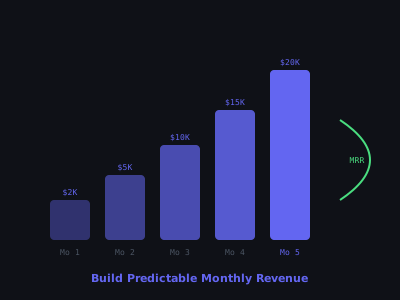
Project revenue is exciting when it comes in and terrifying when it stops. The AI agency owners who build sustainable businesses do not rely on a steady stream of new projects — they convert every project delivery into a monthly retainer. The difference between a $10,000 month and a $10,000 monthly recurring revenue is not the amount of work you do. It is the structure of the relationship. This guide covers the retainer model, pricing tiers, retention systems, and the specific conversations that convert one-time clients into long-term revenue.
Why Retainers Are Structurally Better Than Projects
A project client pays you once and then has no further obligation. A retainer client pays you every month as long as you continue delivering value. For the client, a retainer removes the friction of re-hiring for every new automation need. For you, it creates revenue predictability that makes planning, hiring, and investing in growth possible. You cannot hire a subcontractor when you do not know if you will have revenue next month. You can when you have $15,000 in monthly recurring revenue with contracts that renew automatically.
The second structural advantage of retainers is relationship depth. A project client knows you for six weeks. A retainer client knows you for two years. Long-term client relationships produce referrals, testimonials, case studies, and upsells — all of which compound into agency growth that project work cannot replicate. Every project you complete is an opportunity to convert a transaction into a relationship.
Retainer Pricing Tiers (Monthly)
The Three Retainer Tiers
Tier 1: Maintenance Retainer ($500–$1,500/month)
The maintenance retainer covers monitoring, error response, and basic support for systems you have already built. You get notified if a workflow breaks, you fix it within 24 hours, and you provide a monthly health report. This is the floor of retainer pricing — a minimum viable ongoing relationship. It is appropriate for clients with simple automations who do not have the budget or appetite for ongoing optimization. The risk with this tier is that the client never experiences growing value, which makes renewal conversations difficult. Maintenance retainers also commoditize your service: another agency can offer the same thing for less.
Tier 2: Growth Retainer ($2,000–$4,000/month)
This is the sweet spot. The growth retainer includes everything in the maintenance tier plus a monthly strategy call, one to two new automation builds or significant improvements per month, A/B testing and optimization of existing systems, and priority support. The client experiences continuously increasing value because new automations compound on top of existing ones. After six months on a growth retainer, a client typically has three to five interconnected systems running — missed call text-back, lead nurture sequence, appointment reminders, review requests, CRM sync — each contributing measurable results. That client will not leave, because the cost of switching is the loss of six months of compounded automation infrastructure.
Tier 3: Fully Managed AI Operations ($4,000–$12,000/month)
The fully managed tier positions you as an outsourced AI operations team rather than a vendor. You own the entire automation strategy, build and maintain everything, manage the tools and subscriptions, and provide weekly reporting. Clients at this tier typically have significant revenue at stake — $500,000 or more in annual revenue — and see automation as a competitive advantage rather than a cost to minimize. These clients are rare but transformative for agency revenue. One fully managed client at $8,000 per month contributes as much as five maintenance retainer clients with a fraction of the relationship complexity.
How to Convert Projects Into Retainers
The best time to introduce the retainer conversation is during the project delivery, not at the end. When you are mid-project and the client can see the value taking shape, their receptivity is highest. Schedule a 30-day results review for every project. At that call, present the measurable impact of the work you have done — leads responded to, time saved, appointments booked, revenue attributed — and then offer a monthly program to continue optimizing and expanding the system.
Clients who just experienced results are in the ideal state to say yes to a retainer. Frame the retainer not as ongoing maintenance but as the next phase: "We have built the foundation. Now we have three months of optimization work that will compound these results significantly. Here is what that looks like at $2,500 per month." Agencies that approach every project this way consistently convert 40 to 60 percent of project clients into retainers.
MRR Milestones and What They Require
Reducing Client Churn Below 5%
The most dangerous period for a retainer relationship is months two and three, after the initial excitement of go-live has faded and before the compounding value of optimization is visible. Agencies with high churn rates typically fail to deliver visible results during this window. Agencies with low churn rates proactively demonstrate value every month before the client asks for it.
The four practices that consistently keep churn below 5 percent monthly: first, send a monthly performance report showing concrete metrics — not just system health, but business outcomes like leads captured, appointments booked, revenue attributed, time saved. Second, proactively suggest one new automation opportunity every month, framed as something you noticed would help based on their current usage. This signals that you are thinking strategically about their business, not just maintaining what you already built. Third, run quarterly business reviews where you present a roadmap for the next 90 days. Clients who can see a clear vision of where the engagement is going are far less likely to cancel than clients who feel like they are on a month-to-month maintenance arrangement. Fourth, start renewal conversations 60 days before contract expiry, not two weeks before. Early renewal conversations are strategy discussions. Last-minute conversations feel like pressure.
Scaling MRR Past $20,000
Three levers move MRR significantly: raising prices for new clients, upselling existing clients from lower tiers to higher tiers, and building a referral system that generates warm leads monthly. Raising prices by 20 to 30 percent for all new clients without changing what you deliver is the highest-leverage action most agencies underutilize. If your current growth retainer is $2,000 per month and you raise it to $2,600 for new clients, every new client you add contributes 30 percent more revenue with no change in your work. Existing clients stay at their current price — you only raise rates on new engagements.
For a complete guide on building the referral system that feeds your retainer pipeline, see the AI agency referral strategy guide. For pricing strategy at different agency stages, see the complete pricing guide for AI agency retainers and projects.
Join 215+ AI Agency Owners
Get free access to our all-in-one outreach platform, AI content templates, and a community of builders landing clients in days.