
How to Handle Every Objection When Selling AI Automation Services
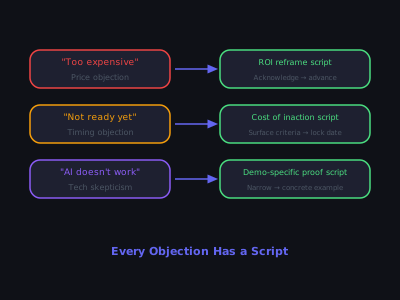
Every AI automation sale runs into objections. The difference between a 20% close rate and a 60% close rate is not your offer, your price, or your case studies — it's how confidently and specifically you handle the friction points that come up in every sales conversation. This guide covers every common objection you'll face and gives you the exact script for each one.
The Mindset Shift: Objections Are Requests for Clarity
Most salespeople hear an objection and feel defensive. The right mental model is the opposite: an objection means the prospect is still engaged. A true "no" is silence — they stop responding. An objection is a question wrapped in resistance. Your job is to unwrap it, address the real concern, and move forward.
The structure for handling every objection is the same: acknowledge, understand, reframe, advance. Acknowledge the concern (don't dismiss it). Ask a clarifying question to understand the root cause. Reframe with evidence or logic. Then advance to the next step.
This framework works because it respects the prospect's intelligence. You're not overriding their concern — you're demonstrating that you've heard it and providing information that changes the equation. People don't buy when their objections are dismissed; they buy when their objections are resolved.
Price Objections
"That's too expensive."
Acknowledge: "I hear you — it's a real investment." Understand: "Help me understand — is it the total number, or the monthly commitment, or the timing?" Reframe: "When you said earlier that fixing this would save your team 12 hours a week — at your team's billing rate, that's roughly $2,400/month of recovered capacity. Our fee is $2,000/month. You're ROI-positive from day one." Advance: "Does it feel more reasonable when you look at it that way?"
The critical move here is using the prospect's own numbers from earlier in the discovery. If you didn't surface those numbers during discovery, you have no ammunition for this moment. That's why deep discovery is the foundation of objection handling — the answers to objections come from questions you asked 20 minutes ago.
"We don't have budget right now."
Understand: "Is budget completely unavailable, or is it more that this wasn't planned for this quarter?" If it's a timing issue: "We can structure the engagement to start with a smaller scope and expand next quarter. What if we began with just the [highest-priority piece] for $1,500/month to demonstrate ROI first?" This creates a stepping-stone that gets the relationship started.
Another approach: "Many of our clients started with a one-time project to prove the concept, then moved to a retainer after seeing results. Would a $3,000 pilot project make more sense as a starting point?" This removes the recurring commitment anxiety while still getting the engagement started.
"Your competitor charges less."
Respond with confidence: "There are definitely cheaper options out there. What I can tell you is that our clients stay with us for 14+ months on average because we focus on results, not just building and leaving. The question isn't who's cheaper — it's who's going to deliver outcomes that justify any investment. Would you like to talk through specifically what's different about our approach?"
"Can you give us a discount?"
Never discount without removing scope. The response: "I can adjust the price if we adjust the scope. For example, we could start with just the [core automation] at $X/month instead of the full package at $Y/month. You'd still get the highest-impact piece, and we can always add the rest later." This maintains your price integrity while giving the prospect a way to move forward at a lower commitment.
Trust and Credibility Objections
"I've never heard of you."
This is an invitation to establish credibility fast. Lead with specifics: "Totally fair — we're selective about how we grow. Here are three case studies from clients in [their industry] with results we can discuss. Would it help to speak with one of them directly?" Offering a reference call is one of the strongest credibility moves available and very few prospects actually take you up on it — the offer itself builds trust.
"How do I know this will actually work for my business?"
Reframe to reduce risk: "That's exactly the right question to ask. Here's how I think about it: we've built [specific system type] for [N] businesses. The results vary, but here's the range: [low end] to [high end]. The main variable is [factor they control]. We also offer a [guarantee or pilot structure] so you can see results before a long-term commitment."
"We had a bad experience with an agency before."
This is gold — don't shy away from it. "Tell me about that. What happened?" Listen fully. Then: "That's a legitimate concern and unfortunately common. Here's specifically how we work differently: [specific process differences]. And here's what a client who came to us after a similar experience had to say: [testimonial]." Past bad experiences make prospects more attentive to differentiation, not less.
"We need to check references first."
Embrace this enthusiastically: "Absolutely — I'd encourage that. I'll send you contact info for two clients in a similar space. While you're doing that, let me also send over our case study document. Can we schedule a follow-up call for [specific date] to discuss once you've had a chance to connect with them?" The key is tying the reference check to a specific next step so momentum doesn't die.
Timing Objections
"We're not ready yet."
Clarify: "What would 'ready' look like — is it a specific milestone, a budget cycle, or something else?" Then challenge gently: "Here's the question I'd ask: the problem you described — [their specific pain] — is costing you [their stated cost] every month you wait. What changes between now and when you're 'ready' that makes that cost acceptable?" This doesn't pressure them — it asks them to reckon honestly with the cost of inaction.
"We're too busy to implement this right now."
This is actually a strong buying signal — they're busy because they have the problem you solve. Respond: "That makes total sense — and it's actually the exact reason our clients hire us. We handle the entire implementation; your team's involvement is minimal. Most clients spend less than 3 hours total during the setup phase. We designed it that way specifically for busy operators."
"Can we revisit this next quarter?"
Agree but anchor: "Absolutely — let's put something in the calendar. Before we do, can I ask: what would need to happen between now and then for you to feel confident moving forward? If I know that, I can prepare accordingly." This turns a vague delay into a qualified future conversation with specific criteria.
"We have other priorities right now."
Explore whether your solution actually supports their priorities: "What are the top priorities competing for your attention right now?" Often, the problem you solve is directly related to one of their stated priorities — they just haven't made the connection. If their priority is "increase revenue," and you automate lead follow-up that recovers lost revenue, your service IS the priority.
Technology Skepticism Objections
"AI doesn't work / isn't reliable enough yet."
Meet them where they are: "I appreciate that skepticism — a lot of the AI hype isn't grounded in real business results. What we do is different: we build specific, narrow automations that do one thing extremely well. We're not selling a magic AI brain — we're building a system that does [specific task] consistently without human error. Here's a concrete example of what that looks like in practice."
"Our team won't use it."
This is a change management objection, not a technology objection. Respond: "Change adoption is real — it's why we build systems that work with your existing tools rather than replacing them. Your team doesn't need to change their workflow; the automation runs in the background. Here's how we typically handle onboarding: [specific onboarding process]."
"What happens if the AI makes a mistake?"
Address the concern directly: "Great question — we build in safeguards at every step. For high-stakes communications, the AI drafts and a human approves before sending. For lower-stakes tasks like data entry or lead routing, we set up monitoring that flags anomalies for review. We also test extensively before going live. In six months of running [similar system], the error rate has been under 2%."
"We tried automation before and it didn't work."
This is an opportunity to differentiate: "What specifically did you try, and what broke down?" Most failed automation attempts fail because of poor setup, lack of ongoing optimization, or the wrong tool for the job — not because automation doesn't work. Once you understand their specific failure, you can explain exactly how your approach avoids that same pitfall.
The "Let Me Think About It" Non-Objection
This is the most common and most evasive non-answer. Never accept it at face value. Respond: "Of course — I want you to feel completely confident. What specifically would be most helpful to think through? Is it the investment, the timeline, how this fits into your priorities, or something about the approach itself?" By naming specific possibilities, you invite them to identify the real hesitation instead of hiding behind a polite deflection.
If they genuinely need time, set a specific follow-up: "Totally understand. Can we schedule a 15-minute call for [specific day] so I can answer any questions that come up? That way you're not waiting on me and I'm not guessing where you landed." A specific follow-up converts at 3-4x the rate of "I'll follow up next week."
Preventing Objections Before They Arise
The best objection handling happens before the objection is spoken. Here are three techniques that dramatically reduce the number of objections you face:
- Surface budget early: Ask about budget range in your pre-call questionnaire or in the first 10 minutes of discovery. If they can't afford you, better to know now than after a 45-minute presentation.
- Address common concerns proactively: "A lot of business owners I talk to are skeptical about AI reliability — and honestly, that skepticism is healthy. Here's how we address it..." Addressing concerns before they become objections makes you look transparent and confident.
- Use social proof throughout: Drop relevant case studies and client quotes throughout your presentation, not just at the end. By the time you present pricing, the prospect has already heard 3-4 proof points that make the investment feel justified.
Authority and Decision-Making Objections
"I need to run this by my partner/board/team."
This is legitimate in many cases, but it can also be a stall tactic. The key move is to make the next conversation productive rather than letting momentum die. Response: "Totally understand — who else is involved in the decision? Would it help if I joined a quick call with them to answer any technical or ROI questions directly? I find that when decision-makers can ask questions in real time, the process moves much faster than passing a proposal back and forth."
If they decline the joint call: "No problem. Would it help if I put together a one-page summary specifically addressing the questions your [partner/board] is likely to ask? I've done this for other clients in your situation and it tends to speed things up." This gives them a tool to sell internally on your behalf, which is far better than leaving them to explain your service from memory.
"We need to get IT involved."
For enterprise and mid-market prospects, IT involvement is expected. The mistake is treating this as a roadblock rather than a step in the process. Response: "That makes sense. We work with IT teams regularly and I'm happy to jump on a technical call to address security, data handling, and integration questions. What's the best way to set that up — should I reach out directly, or would you prefer to make the intro?"
Objection Frequency by Sales Stage
The Objection Recovery Sequence
When a prospect objects and you handle it well but they still don't close on the call, use this 5-day follow-up sequence. The sequence is designed to maintain momentum while respecting the prospect's decision process:
- Day 0 (same day, within 2 hours): Send a brief email summarizing the call and addressing their specific objection with additional evidence (a case study, a testimonial, a data point). Reference their exact words: "You mentioned [their concern]. Here's how [similar client] addressed that same question..."
- Day 2: Share a relevant piece of content — a blog post, a video walkthrough, or a client success story that directly relates to their concern. Frame it as genuinely useful, not as a sales push: "Thought this might be relevant to what you're evaluating..."
- Day 5: Send a direct check-in: "Wanted to follow up on our conversation. Have any new questions come up? I'm happy to jump on a quick call to work through anything. Also, I have two implementation slots opening up next month — wanted to mention it in case timing is a factor."
After day 5, if there's no response, move them to a monthly nurture cadence. Chasing beyond this point rarely closes deals and signals desperation. The monthly nurture should be content-driven — send them relevant posts, case studies, or industry insights once per month to stay top of mind without being pushy.
Building Objection Handling Into Your Sales Process
The best sales processes do not just react to objections — they anticipate and prevent them. Here is how to build objection prevention into every stage of your pipeline:
- Pre-call qualification: Ask about budget range, decision-making process, and timeline in your booking form or pre-call email. This surfaces potential objections before the call happens, giving you time to prepare specific responses.
- Discovery stage: Ask "what concerns do you have about working with an AI automation agency?" directly. Most prospects will tell you their objections when asked, and addressing them proactively builds trust. See our discovery call script guide for the complete framework.
- Proposal stage: Include an FAQ section in your proposal that preemptively addresses the three most common objections for your service tier. This shows the prospect you understand their concerns and have thought about them carefully.
- Follow-up stage: Use the objection recovery sequence above with content specifically selected to address the prospect's stated concern.
For the cold outreach that fills your pipeline with prospects in the first place, see our post on AI cold email personalization at scale. And for the LinkedIn strategies that generate warm prospects who have fewer objections from the start, check our LinkedIn outreach sequence templates.
Frequently Asked Questions
Want to learn how to build and sell AI automations? Join our free community. Join the free AI Automation Sprint community.
Join 215+ AI Agency Owners
Get free access to our all-in-one outreach platform, AI content templates, and a community of builders landing clients in days.