
LinkedIn B2B Lead Generation 2026: The Complete Strategy Guide
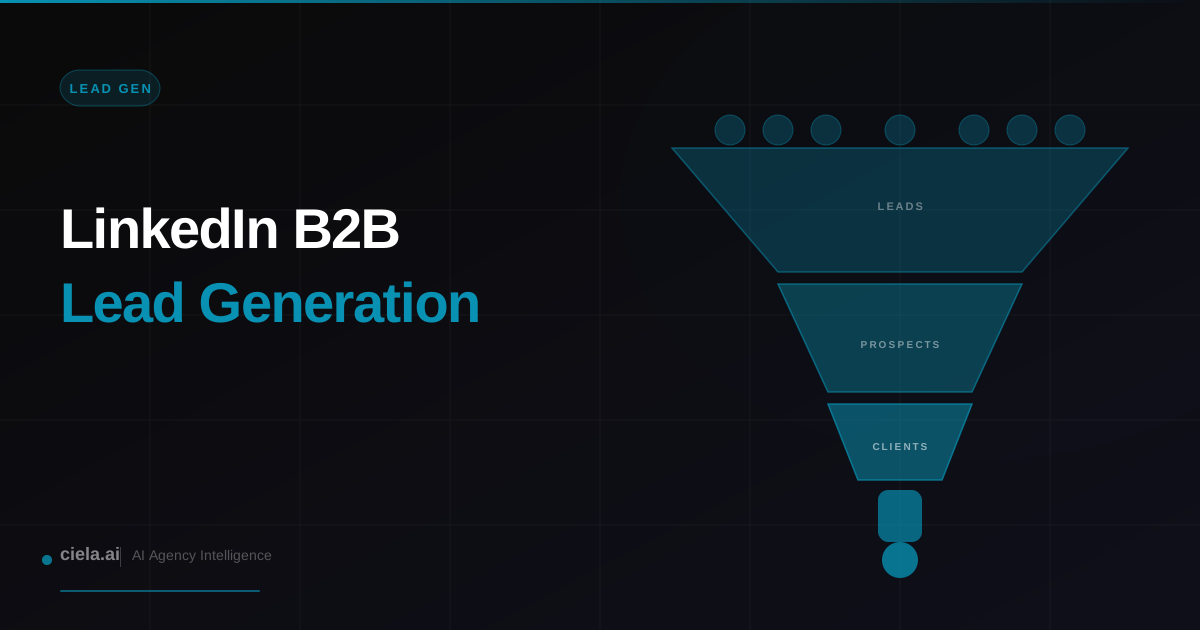
LinkedIn remains the highest-ROI B2B lead generation channel available to AI agency owners — not because it is easy, but because of the density of qualified decision-makers in one place. The business owner who would ignore a cold email or skip a Google ad is actively engaging with content in their LinkedIn feed every morning. The question is not whether to use LinkedIn for lead generation — it is whether you are using it correctly.
The most common mistake is treating LinkedIn as a mass cold outreach platform. Spray-and-pray connection requests and copy-paste DMs produce low response rates and damage your reputation with exactly the people you want to reach. The highest-performing LinkedIn lead generation in 2026 combines strategic content (pull) with targeted outreach (push) in a coordinated system where each amplifies the other.
The Pull System: Content That Attracts Buyers
Content is your most powerful lead generation tool on LinkedIn because it works passively at scale. A post about a specific client result reaches hundreds or thousands of people in your target audience without any individual effort beyond the writing. When that post resonates with someone experiencing the same problem, they visit your profile, read your About section, and in many cases reach out proactively.
For AI agency owners, the content that generates the most qualified inbound is highly specific: specific industry, specific problem, specific result, specific mechanism. A post that says "We helped a 12-person HVAC company recover $4,200 in missed jobs in 30 days using an AI text-back system" reaches every HVAC owner in your LinkedIn network and causes every one of them to wonder if the same thing is happening to them. That post does more prospecting work than 100 cold DMs to the same audience.
LinkedIn Lead Gen Channel Performance for AI Agencies
The Push System: Targeted Outreach That Converts
Cold outreach on LinkedIn still works — but only when it is genuinely targeted and genuinely personal. The framework that converts in 2026 is what some call "warm cold outreach" — reaching out to people who have interacted with your content, visited your profile, or are in the same communities as your existing clients. These are not cold prospects in the traditional sense. They have already had some exposure to you, which dramatically changes the response dynamic.
The sequence: first, connect with your target prospects (ideally with a brief personalized note). Second, engage meaningfully with their content for 5 to 7 days — substantive comments that demonstrate you understand their industry. Third, send a DM that references something specific from their content or their business, not a generic pitch. Fourth, make a concrete but low-commitment ask: not "want to hop on a call?" but "I noticed you do X — I just wrote something relevant to that, would it be useful to share it with you?"
Building Your Ideal Client List on LinkedIn
LinkedIn's search is one of the most powerful B2B prospecting tools available. You can filter by job title, industry, company size, location, seniority level, and keyword. For an AI agency targeting HVAC businesses, a search for "HVAC owner" or "HVAC general manager" in a specific metropolitan area returns a highly targeted list of exactly the decision-makers you want to reach. Save searches that match your ideal client profile and revisit them weekly to identify new prospects.
LinkedIn Sales Navigator amplifies this capability significantly — the ability to track prospect activity, get alerts when prospects change jobs or post new content, and filter by growth signals (hiring activity, funding rounds, technology used) creates a qualitatively different prospecting experience. For AI agency owners with a clear niche, the ROI on Sales Navigator is typically justified once you have validated your offer and have a working outreach sequence.
The Warm Outreach Sequence
Day 1: Connect with a personalized note that references something specific about their business or a post they made. Day 3: Comment substantively on one of their posts. Day 7: Send a DM that opens with a genuine observation about their business, shares a relevant piece of content, and asks a question rather than pitching. Day 14: If no response, follow up once with a different angle — a new piece of content, a question about a specific challenge in their industry, or a case study relevant to their situation.
The key to this sequence is the genuine personalization at each step. It takes more time than bulk outreach, but the response rates are dramatically higher — often 3 to 5x the rate of generic sequences. For a full guide to building outreach sequences that convert, see our post on LinkedIn outreach sequences for AI agency owners.
Warm vs. Cold Outreach Conversion Rates
Tracking and Optimizing Your LinkedIn Lead Gen System
Without tracking, you cannot optimize. Every week, log three numbers: connection requests sent, acceptance rate, and DMs sent to conversations started. Over four to six weeks, you will have enough data to identify where the system is breaking down. If your connection acceptance rate is low, your connection note is the problem. If connections accept but conversations do not start, your DM opener is the problem. If conversations start but do not convert to discovery calls, your transition from conversation to ask is the problem. Fix the specific bottleneck rather than overhauling the whole system.
For AI agency owners with consistent content, a fully functioning LinkedIn lead gen system — content driving inbound awareness, warm outreach converting the most engaged prospects, and referrals from satisfied clients amplifying both — is capable of generating 5 to 15 qualified discovery calls per month at a cost measured only in time. That is the pipeline density that supports a $10K to $30K per month AI agency without any paid advertising.
Join 215+ AI Agency Owners
Get free access to our all-in-one outreach platform, AI content templates, and a community of builders landing clients in days.