
How to Write a LinkedIn About Section That Attracts AI Agency Clients to You
Your LinkedIn About section is the most underused real estate on your entire profile. Most people either leave it blank, paste in their resume summary, or write a generic paragraph about being "passionate about innovation." None of these convert visitors into leads.
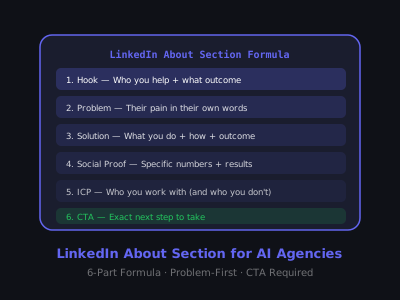
A well-written About section does three things: it tells the right person they have found exactly what they are looking for, it builds enough credibility to justify a conversation, and it makes the next step obvious. Here is the formula — with examples specific to AI agency owners.
Why Most LinkedIn About Sections Fail
The core problem with most About sections is they are written for the wrong audience. People write about themselves — their journey, their certifications, their interests. But your About section is read by a prospect who is evaluating whether you can solve their problem. They do not care about your journey until they believe you can help them.
The reframe: write your About section as if it is a landing page for a single type of buyer. Start with their problem, not your background. This single shift transforms a forgettable bio into an inbound lead machine.
About Section Elements That Drive Inbound Inquiries
The 6-Part About Section Formula
Part 1: The Hook
The first line is visible before the "See more" fold — it is the only text most profile visitors read before deciding whether to expand. It must immediately signal who you help and what you deliver.
A weak hook reads: "I am an AI automation specialist with 5 years of experience in workflow optimization." A strong hook reads: "I help B2B service businesses stop losing leads to slow follow-up — by building AI systems that respond, qualify, and nurture 24/7 without adding headcount." The strong version names a specific problem, a specific outcome, and implicitly names the buyer. Someone who fits this description will click "See more" immediately.
Part 2: The Problem You Solve
Describe the pain your ideal client is experiencing in their own language. The goal is for them to read this and think "that is exactly what I am dealing with." Most growing service businesses reach a breaking point where they have more leads than their team can handle — but they are not ready to hire three more salespeople. Leads go cold. Follow-ups get missed. Deals fall through the cracks. Notice this paragraph says nothing about AI or automation yet. It describes the buyer's reality. This is intentional — empathy before solution.
Part 3: What You Do and How
Now introduce your solution in plain English. Avoid jargon, tool names, and technical details at this stage. Focus on the mechanism and the outcome. Example: "I build custom AI automation systems that handle the follow-up, qualification, and nurturing work your team does not have time for. Every system I build is designed for a specific business — not a template dropped into your CRM. Most clients see their response times drop from hours to minutes and their booked calls increase by 30-50% within the first 30 days."
Part 4: Social Proof
One to two specific results or client examples build more credibility than a list of logos or certifications. If you are early and do not have client results, use results you achieved for yourself or describe the type of outcomes you are able to produce. Specific numbers, specific industries, specific outcomes — these details make results feel real rather than inflated. Example: "Recent projects include a 3-step AI follow-up system for a 12-person solar sales team that recovered $180,000 in lost pipeline in 60 days."
Part 5: Who You Work With
Explicitly name your ideal client. This serves two purposes: it attracts the right people and it repels the wrong ones, saving you wasted discovery calls. Example: "I work best with B2B service businesses doing $500K-$5M in annual revenue that have a proven offer and a sales process — but are losing deals to operational gaps. If you are pre-revenue or just testing an idea, I am probably not the right fit yet." The explicit exclusion signals confidence and selectivity — both of which increase perceived value.
Part 6: The CTA
Tell the visitor exactly what to do next. A clear, specific CTA doubles the conversion rate compared to no CTA. Example: "If you are losing leads to slow follow-up or your team is spending too much time on tasks AI could handle — send me a message with a brief description of your situation and I will tell you whether there is a fit." The phrase "tell you whether there is a fit" positions you as selective rather than desperate.
About Section Conversion Rate by Writing Approach
Niche-Specific Hook Examples
The formula stays the same across niches, but the language should change dramatically based on who you serve. A dental practice owner and a SaaS VP of Sales have completely different vocabularies, pain points, and buying criteria.
For real estate agencies: "I help real estate teams respond to every lead in under 60 seconds — with AI that qualifies, nurtures, and books showings automatically." For SaaS companies: "I build AI systems that turn your demo request form into a qualification engine — so your SDRs only talk to prospects who are ready to buy." For home service businesses: "I help HVAC, roofing, and plumbing companies convert more website visitors into booked jobs — with AI that answers calls, qualifies leads, and schedules estimates 24/7." Notice each hook names the specific niche, the specific problem, and the specific mechanism. A prospect in any of these niches reads the hook and immediately thinks, "This person understands my world."
Common About Section Mistakes
Starting with "I" is the most common mistake — lead with the reader's problem, not your story. Listing tools and certifications is equally damaging because prospects care about outcomes, not your tech stack. Buzzwords like "passionate," "results-driven," and "innovative" are noise that signals a generic operator. Every About section needs a clear next step, and walls of text kill readability — use line breaks generously since LinkedIn is a mobile-first platform.
Testing and Iterating Your About Section
Your About section is not a set-it-and-forget-it element. Treat it like a landing page and test it. Change your hook, monitor profile views and inbound messages for two weeks, then compare against your previous version. The metric that matters most is inbound DMs from qualified prospects — not profile views alone. Ask three to five people in your target market to read your About section and tell you what they think you do. If they cannot summarize your offer in one sentence, your messaging is not clear enough.
Review your About section every 90 days and update the social proof paragraph with your most recent and most impressive results. As you accumulate strong case studies, your About section becomes a powerful inbound asset. For a complete picture of how every profile section works together to drive discovery calls, read our guide on LinkedIn About section examples for AI agency owners.
The About Section Is One Piece of the Profile
A great About section drives profile visitors deeper into your profile — but the rest of your profile needs to deliver on the promise. Your headline, featured section, and experience entries all work together with the About section to create a coherent case for why a prospect should book a call. Once your profile is optimized, the next step is building an outreach system that sends targeted prospects to it. Our guide on LinkedIn outreach sequences covers the full system.
Join 215+ AI Agency Owners
Get free access to our all-in-one outreach platform, AI content templates, and a community of builders landing clients in days.