
How to Follow Up on Cold Emails Without Being Annoying or Getting Blocked
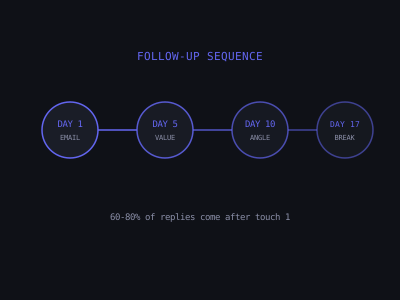
Studies consistently show that 60 to 80 percent of replies in a cold email sequence come from follow-up emails, not the initial send. Skipping follow-ups leaves the majority of potential meetings on the table. But the difference between a follow-up sequence that generates meetings and one that generates spam complaints is the approach: each follow-up must add new value rather than simply asking again. This guide covers the exact timing, structure, and content of cold email follow-ups that get responses without annoying prospects or damaging your sender reputation.
The Core Rule: Every Follow-Up Must Add Value
"Just bumping this to the top of your inbox" is the most common cold email follow-up in existence, and it is the worst one. It adds no new information, provides no new reason to respond, and signals to the recipient that you have nothing new to offer. The baseline rule for every follow-up is that it must contain something the previous email did not: a new angle, a relevant piece of data, a case study, a question that invites engagement, or a specific insight about their business. If you cannot identify what new value the follow-up adds before writing it, write something else first.
Reply Distribution Across a 4-Touch Sequence
The 4-Touch Sequence That Works
Four total touches — the initial email plus three follow-ups — is the sweet spot for most cold email campaigns. This captures the majority of potential replies while keeping spam complaint rates low. More than five touches rarely generates incremental replies and significantly increases negative responses and unsubscribes.
Initial Email (Day 1)
The initial email should be short, personalized, and end with a single low-friction call to action. Under 100 words. One clear ask — typically a 15-minute call or a simple yes/no question. Do not pitch everything at once. Your goal is a reply, not a sale in one email.
Follow-Up 1 (Day 5-6): Add a Case Study or Relevant Data
Wait four to five business days before the first follow-up. This gives the recipient time to see and process the original email without feeling pressured. The first follow-up adds one concrete piece of evidence: a specific result you achieved for a similar client, a relevant industry statistic, or a quick insight about their specific business type. Keep it under 80 words. Send as a reply to the original thread so the context is preserved. Example: "Wanted to share a quick data point — a roofing company similar to yours recovered 22 jobs from a dead lead list using automated follow-up. We built that in about a week. Worth a 15-minute call?"
Follow-Up 2 (Day 11-12): Approach From a Different Angle
The second follow-up takes a completely different angle than the first two messages. If the first email focused on speed of response, this one focuses on revenue impact. If the first focused on a specific pain, this one asks a question about a different aspect of their business. The goal is to give prospects who did not respond to the first angle a fresh reason to engage. Try a question format: "Quick question — when a lead comes in after hours, what happens to it right now?" A direct question about their current situation has a much higher response rate than another value proposition at this stage.
Follow-Up 3 (Day 19-20): The Break-Up Email
The break-up email signals that this is your last message and you will stop reaching out. It works because it removes the perceived social pressure to respond and makes it safe for the prospect to reply on their own terms. Many prospects who were interested but busy respond to break-up emails specifically because the low-pressure framing makes it feel safe. Keep it under 60 words. Do not make it dramatic. A simple, direct note: "[Name] — I have reached out a few times and want to respect your time. If the timing is not right, no problem at all. If it ever makes sense to explore this, you can always book time at [link]. Wishing you well either way."
The Timing Rules
Wait four to five business days before follow-up one, five to six days before follow-up two, and seven to eight days before the break-up email. Never follow up daily or every other day — this signals desperation and triggers spam complaints faster than any other pattern. Send on weekday mornings between 8 AM and 11 AM in the recipient's timezone. Avoid Mondays (inbox backlog), Fridays (mentally checked out), and weekends entirely.
For optional long-game re-engagement, wait 45 to 60 days after the break-up email and send a fresh thread with new context. Something relevant that happened in the intervening months — a new case study, a relevant industry development, or a new service you are offering — gives a legitimate reason to reconnect. This "long game" follow-up generates meaningful responses from prospects who were genuinely interested but had something in the way at the time.
Reply Detection and Stopping the Sequence
The most critical technical aspect of any cold email sequence is reliable reply detection. If someone replies — even with a "not interested" — your system must immediately remove them from the sequence. Continuing to send emails to someone who has replied, regardless of what they said, is the fastest way to generate spam complaints and damage your sender reputation. Build reply detection into every sequence from day one, not as an afterthought.
In n8n or Make.com, implement reply detection by monitoring the sending inbox for replies to threads from your sequence. Match the reply's "In-Reply-To" header to outbound message IDs stored in your lead tracker. When a match is found, immediately update the contact's status to Replied and stop any pending sequence steps. Send a Slack alert to the team so someone can respond personally if appropriate. For the complete infrastructure guide, see cold email infrastructure setup guide and how to write cold email sequences that convert.
Follow-Up Sequence Health Metrics to Monitor
☐ Open rate by touch (Email 1 should be highest)
☐ Reply rate by touch (break-up often highest per send)
☐ Spam complaint rate (keep below 0.1%)
☐ Unsubscribe rate (high unsubscribes = wrong targeting)
☐ Positive reply rate (INTERESTED classification)
☐ Time from sequence start to first meeting booked
Join 215+ AI Agency Owners
Get free access to our all-in-one outreach platform, AI content templates, and a community of builders landing clients in days.