
How Much Money Can You Actually Make With an AI Automation Agency?
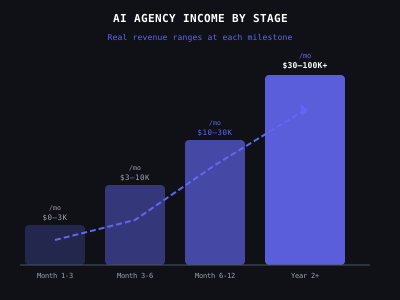
Let's skip the hype and talk actual numbers. If you're researching AI automation agencies, you've probably seen screenshots of $30,000 months and heard stories of people replacing their salary in 60 days. Some of those stories are real. Many are cherry-picked. What you rarely see is the full distribution — the full range of what people actually make at different stages.
This post breaks down the real revenue numbers, the math behind them, what determines where you land in the range, and what the realistic ceiling looks like if you build this properly. No inflated projections, no survivorship bias — just the honest financial picture of running an AI automation agency at each stage of growth.
The Revenue Model: How AI Automation Agencies Make Money
Before getting into numbers, it helps to understand the revenue structure. Most AI automation agencies charge in three ways:
- Setup fees: One-time charges for building the initial automation. Range: $500 to $10,000+ depending on complexity and client size.
- Monthly retainers: Ongoing fees for maintenance, monitoring, optimization, and support. Range: $300 to $3,000+ per month per client.
- Project fees: One-off charges for new automations added to an existing account. Essentially new setup fees for upsells.
The most durable AI automation agencies build toward a primarily retainer-based model. Setup fees give you cash flow but are unpredictable. Retainers give you the monthly recurring revenue (MRR) that makes the business stable, forecastable, and valuable.
For a deep dive on building your retainer model, see our guide on creating predictable recurring revenue with an AI automation agency.
Revenue Source Mix by Agency Stage
Stage 1: Zero to First Client ($0-$3,000/month)
The first stage is the hardest. You're learning the tools, learning to sell, building your first portfolio, and often doing work for below-market rates to get case studies.
Typical revenue: $0 to $3,000/month
Typical timeline: Months 1-3
Common structure: 1-2 clients. One pilot project at a discounted rate to generate proof. Setup fees in the $500-$1,500 range. Monthly retainer of $300-$600 per client.
At this stage, most agency owners are still working a day job or have modest savings covering living expenses. This is not the stage where the business replaces income — it's the stage where you learn the fundamentals.
The people who get through this stage fastest are those who already have relationships in a specific industry. A former insurance agent who can call 20 insurance brokers they already know will land a first client far faster than someone who's cold calling strangers.
The key financial lesson at this stage: do not obsess over revenue per hour. Your first few projects will feel underpriced relative to the hours invested. That is normal. You are simultaneously learning your craft, building case studies, and developing the sales process that scales. The ROI on these early projects comes in the form of portfolio proof and confidence, not direct income.
For a realistic timeline breakdown, see our post on how long it takes to get your first AI automation client.
Stage 2: Finding Your Footing ($3,000-$10,000/month)
By month 3-6, most serious agency owners have 3-6 clients and are generating meaningful revenue. They've delivered a few projects, have at least one case study, and are getting better at both selling and building.
Typical revenue: $3,000 to $10,000/month
Typical timeline: Months 3-9
Common structure: 4-8 clients. Setup fees rising to $1,500-$3,000. Monthly retainers in the $800-$1,500 range. A few upsells starting to appear.
Here's the math for the midpoint of this range (~$6,000/month):
- 5 clients at $1,000/month retainer = $5,000 MRR
- 1 new setup fee at $1,500 = $1,500
- Total: $6,500/month
This is a viable side income for most people, and for some it's enough to leave a day job, especially if they're in a lower cost-of-living area or have minimal fixed expenses.
The critical transition at this stage is developing a repeatable sales process. In stage one, every client was different — different pitch, different offer, different pricing. By stage two, you should be converging on a standard offer that you can present consistently to similar prospects. This standardization is what makes the jump to stage three possible, because it reduces the time and energy required to close each new client.
Stage 3: Real Traction ($10,000-$30,000/month)
At this stage, the agency owner has refined their niche, has a repeatable sales process, and is delivering consistently good results. Referrals are starting to come in. They may be starting to think about hiring a VA or subcontractor to help with delivery.
Typical revenue: $10,000 to $30,000/month
Typical timeline: Months 6-18
Common structure: 10-20 clients. Strong niche positioning (e.g., "AI automation for dental practices in Texas"). Higher ticket setup fees ($3,000-$7,000). Retainers at $1,000-$2,000/month. Active upsell program.
Here's the math for $20,000/month:
- 12 clients at $1,200/month retainer = $14,400 MRR
- 2 new setups at $2,500 each = $5,000
- 2 upsells at $500 each = $1,000
- Total: $20,400/month
This is a full-time income that supports most lifestyles comfortably. Agency owners at this level typically work 40-50 hours per week, much of which is split between sales, delivery, and client management.
The financial inflection point at this stage is upselling. Adding a $500/month service to an existing client requires zero acquisition cost and often takes a single conversation. An agency with 12 clients that successfully upsells four of them adds $2,000/month in pure profit with almost no additional work. Upselling is by far the highest-ROI revenue activity at this stage.
For the complete playbook on reaching this level, see our guide on building a $10K/month AI automation agency.
Profit Margin by Agency Stage
Stage 4: Scaled Operation ($30,000-$100,000/month)
Reaching this stage requires systematization. The founder is no longer doing most delivery themselves — they have team members or contractors handling builds and client communication. They've developed productized service packages that make selling and delivering more efficient.
Typical revenue: $30,000 to $100,000/month
Typical timeline: Year 2-3+
Common structure: 25-60+ clients. Productized packages. Team of 2-5 people. Possible white-label services sold through partner agencies. High-ticket enterprise contracts in the $5,000-$15,000/month range.
Here's the math for $50,000/month:
- 30 clients at $1,200/month = $36,000 MRR
- 5 new setups at $3,000 each = $15,000
- Total: $51,000/month
- Less team costs (2 contractors at $5,000 each) = $41,000 net
At this level, the business owner's primary job shifts to sales, strategic partnerships, and managing the team. Delivery is largely delegated. The key financial skill at this stage is managing cash flow across payroll, tools, and variable revenue. The biggest financial risk is client churn — losing three clients in one month represents a $3,600 MRR hit that takes weeks of sales activity to replace.
What Determines Where You Land in the Range
Within each stage, the single biggest variable is niche specificity. Agency owners who serve a specific industry with a specific offer earn significantly more than generalists, because:
- They can charge more (they're specialists, not generalists)
- They close faster (they deeply understand the client's world)
- They deliver better results (they've solved the same problem many times)
- They get more referrals (word spreads within industries)
The second biggest variable is outreach consistency. The agencies that grow fastest are the ones with disciplined, daily outreach habits. Sending 20 personalized cold emails per day is a simple habit that compounds dramatically over 90 days. At a conservative 3% reply rate and a 25% close rate on replies, 20 emails per day produces roughly 4-5 new clients per quarter. That is the difference between stagnation and growth.
Third is pricing confidence. Many beginner agency owners significantly undercharge out of fear. Charging $500/month when the same service could command $1,500 based on demonstrated ROI means you need three times as many clients to hit your revenue targets. Learning to price based on value rather than cost is a skill that directly multiplies income.
For strategies on raising your prices without losing clients, see our guide on AI agency pricing for retainers and projects.
The $100K+ Month: Is It Real?
Yes, some AI automation agencies generate $100,000+ per month. These are typically not pure service agencies — they've evolved into hybrid models that include:
- White-label services sold to other agencies or consulting firms
- SaaS components built on top of their automation infrastructure
- Enterprise contracts with larger companies
- Training programs or communities for other agency owners
- Equity or revenue-share arrangements with clients
A pure service agency with a team can reach $100K/month, but it requires significant scale and strong systems. It's a realistic 3-5 year goal for someone who builds seriously and systematically. The most common path to $100K months involves at least two revenue streams — typically a service-based retainer book combined with one scalable component like white-label reselling or a productized SaaS tool.
Profit Margins: What You Actually Keep
Revenue is only half the picture. Here are rough margin expectations at different stages:
- Solo, early stage: 80-90% margins (minimal costs, mostly your time)
- Solo, established: 75-85% margins (tool subscriptions, software)
- Small team: 55-70% margins (contractors, tools, admin)
- Scaled agency: 40-60% margins (team salaries, office, infrastructure)
This is one of the most attractive aspects of the agency model at early stages: it's an extremely high-margin business compared to product companies, retail, or most brick-and-mortar businesses. Your primary investment is your time and a few hundred dollars per month in SaaS subscriptions.
Monthly Costs at Each Stage
Understanding your cost structure helps you forecast take-home pay more accurately:
- Solo, early stage ($0-$10K/month revenue): $50-$150/month in tools (n8n, OpenAI API, Twilio). Nearly everything else is your time.
- Solo, established ($10K-$20K/month): $200-$500/month in tools plus $500-$1,500 for a part-time VA. Total overhead: $700-$2,000/month.
- Small team ($20K-$50K/month): $500-$1,000 in tools, $3,000-$8,000 in team payroll, $200-$500 in admin costs. Total overhead: $3,700-$9,500/month.
- Scaled ($50K+/month): $1,000-$2,000 in tools, $8,000-$15,000 in team payroll, $500-$1,000 in admin and marketing. Total overhead: $9,500-$18,000/month.
The Income Path Most People Follow
Mapping out a realistic income trajectory for someone starting from scratch:
- Month 1-2: $0 (building skills, starting outreach)
- Month 3: $1,000-$3,000 (first client)
- Month 6: $4,000-$8,000 (3-5 clients)
- Month 9: $8,000-$15,000 (5-8 clients, some at higher rates)
- Month 12: $12,000-$20,000 (8-12 clients, first hire)
- Month 18: $20,000-$35,000 (10-15 clients, small team)
- Month 24: $30,000-$50,000 (15-25 clients, proven systems)
These numbers assume consistent effort, niche focus, and a willingness to raise prices as you gain experience. The variance is high — some people reach $20K/month in 6 months, others take 18 months. The difference is almost always about outreach consistency and niche specificity, not technical skill.
The Hidden Financial Advantage: Recurring Revenue
The most underappreciated financial aspect of the AI automation agency model is the compounding nature of recurring revenue. Every client you sign on a monthly retainer adds permanently to your baseline income until they churn. Unlike project-based businesses where you start at zero every month, a retainer-based agency starts each month with guaranteed revenue.
At 10 clients paying $1,500/month, you wake up on the first of every month with $15,000 already earned before doing any new work. That is a fundamentally different financial position than a freelancer or project-based consultant who starts each month at zero. This recurring revenue base changes your relationship with risk, reduces the pressure on sales, and makes it possible to invest in growth without desperation.
For more on how to structure and grow your agency, see our guide on how to start an AI automation agency in 2026 and our AI agency pricing guide for retainers and projects.
Frequently Asked Questions
Want to learn how to build and sell AI automations? Join our free community. Join the free AI Automation Sprint community.
Join 215+ AI Agency Owners
Get free access to our all-in-one outreach platform, AI content templates, and a community of builders landing clients in days.